Kunzea Week runs Monday 7 September to Sunday 13 September 2026.
The timing is not arbitrary. Early September is when Kunzea ambigua starts to flower across Tasmania and the south-east coast. For eleven months of the year it is unremarkable scrub, a stiff, upright shrub of two or three metres that bushwalkers push past without a second look. Then it covers itself in masses of small creamy-white flowers, borne in heavy sprays, almost all stamen with the tiny petals hidden underneath.1 A hillside of it in bloom looks like low cloud sitting on the scrub. Botanically it is Kunzea ambigua. Along the coast it is better known as Tick Bush.
The flowers smell like honey. That is not a figure of speech. Bees work the blossom hard through September and October, and that is exactly where Kunzea Honey comes from.
So Kunzea Week is a week for the plant. Not for a product range, and not for one company. Kunzea turns up as an essential oil, a raw single-origin honey, a dried culinary leaf and a topical cream, and almost nobody outside Tasmania knows any of it exists. A week seems a reasonable place to start fixing that.
What is Kunzea Week?
Kunzea Week is a week set aside each September to mark the start of Kunzea ambigua's flowering season. Kunzea Week 2026 runs Monday 7 September to Sunday 13 September, chosen because it lines up with something real in the bush rather than a date picked at random. It grows out of World Kunzea Day, which Zea has marked in recent years, now moved into a defined week timed to flowering. 2026 is the first year it runs this way.
That is the whole idea in one paragraph, because it should be searchable. If the question is "what is Kunzea Week" or "when is Kunzea Week 2026", that is the answer: a week, in early September, timed to the point Kunzea begins to flower.
Why Kunzea earns a week
Lavender has its regions and its festivals. Sequim, Washington calls itself the Lavender Capital of North America, and its festival has run for decades. Beaumont, California grew a regional celebration of lavender farming into a multi-week event. Santa Barbara runs a Lavender Festival built around local farms and small businesses, and Denver Botanic Gardens marks its own lavender bloom as a public garden event. None of those belong to a single company. They belong to a plant, a place and a season, celebrated by everyone who grows it, works with it or simply lives near it.
Kunzea has never had that moment, even though it earns one. It is a native Australian shrub, growing wild across parts of Tasmania, Victoria and New South Wales,2 used in Tasmania for generations as a bush remedy, the leaf rubbed straight onto sore muscles. Unlike Tea Tree or Lavender, it has stayed a local, half-known thing. Kunzea Week is an invitation to give it the wider recognition those other plants already have, framed the same way: plant, place, season, and everyone who works with it, growers, beekeepers, distillers, cooks, aromatherapists and bushwalkers alike.
The flowering season
The Australian National Botanic Gardens records Kunzea ambigua's flowering period as running from September to early November, with masses of small, honey-scented white flowers borne in heavy sprays along the branch tips.1 Early September is the start of that window, the point a Kunzea stand begins moving out of its winter shape and into bloom.
Bloom timing matters twice over. Kunzea oil is steam distilled from the leaf and fine branch material, and the plant's chemistry shifts through the growing season, so flowering is the visible marker that the cycle the oil depends on has properly begun. It matters just as much to the bees. Honey bees forage Kunzea blossom directly, and a single-origin Kunzea Honey depends entirely on the plant flowering in enough volume, in the right place, at the right time. One plant, two entirely different products, both keyed to the same few weeks in the bush.

The many faces of Kunzea
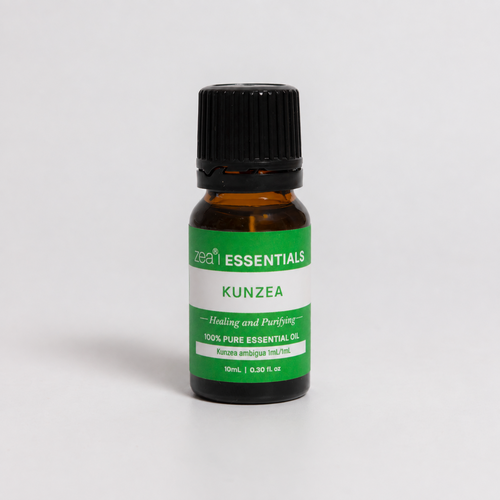
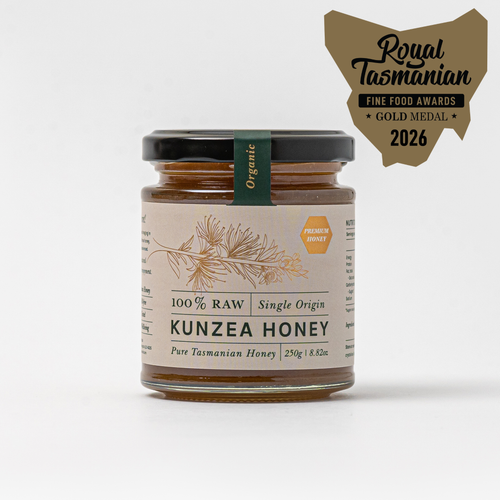
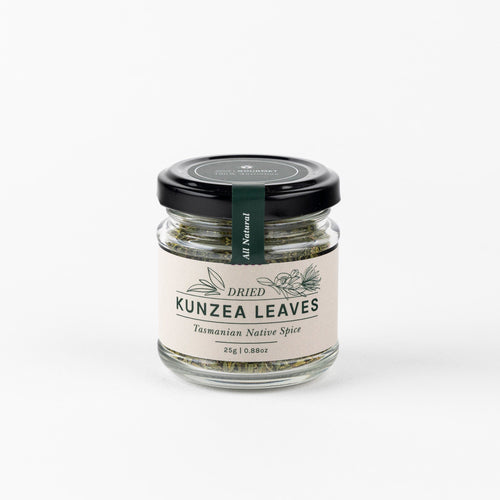
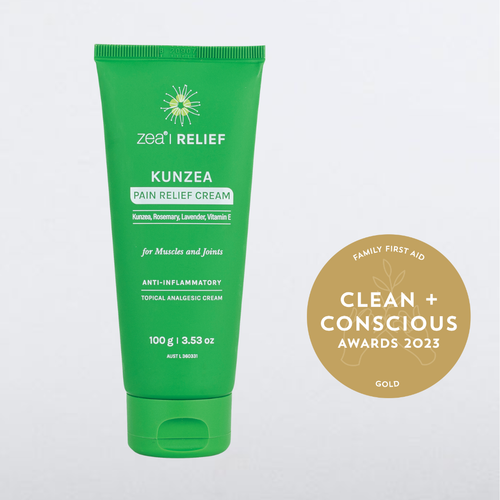
Most people meet Kunzea in one form and assume that is the whole story. It isn't. The same plant shows up as an essential oil, a raw honey, a dried botanical and a topical cream, each made differently and used for a different purpose.
| Form | What it is | How it is used |
| Kunzea Essential Oil | Steam distilled from Kunzea leaf and fine branch, plantation-grown as well as wild harvested in Tasmania | Aromatherapy and topical blends, used in a diffuser or diluted for massage |
| Kunzea Honey | A single-origin raw honey, made by bees foraging Kunzea blossom | Eaten as a table honey, valued for its distinct flavour and provenance |
| Dried Kunzea Leaf | The raw botanical leaf, dried whole | Infusions and culinary use, and the closest thing to meeting the plant itself |
| Kunzea Pain Relief Cream | A topical cream formulated with Kunzea oil, registered with the ARTG as a listed medicine (AUST L 360 331) | Applied topically for relief from muscle aches and soreness |
Kunzea Honey and Dried Kunzea Leaf are foods, valued for flavour and provenance rather than any health outcome. Kunzea Essential Oil in its raw form is an aromatherapy ingredient, not a therapeutic product. Only Kunzea Pain Relief Cream carries a therapeutic listing, and even that is limited to what the ARTG entry actually permits.
How to take part
Kunzea Week is open to anyone, and none of it requires spending anything:
- Learn to spot it. Anyone in Tasmania or southern Australia in early September can watch for Kunzea in flower along roadsides and coastal scrub. The blossom is distinctive once the shape is familiar.
- Try the oil. A bottle of Kunzea Essential Oil sitting in a cupboard is worth using this week, in a diffuser or diluted for a massage blend.
- Taste the honey. Kunzea Honey is a single-origin honey worth trying on its own, spread or stirred through, to notice what makes it distinct from a general wildflower blend.
- Cook with the leaf. Dried Kunzea Leaf can be steeped as an infusion, the simplest way to meet the raw plant.
- Share a photo. A photo of Kunzea in flower, wherever it is spotted, is welcome and worth sharing.
- Read the science. Start with what Kunzea oil actually is, how it compares with Tea Tree oil, and what the ARTG listing does and does not cover for joint discomfort. The Ingredient Glossary covers the rest of the range.
The full Kunzea range is worth a look for anyone wanting to see all four forms in one place. Content runs across the week to accompany all of this, without a single fixed schedule attached.
What's next
The ambition for Kunzea Week is that it becomes something Tasmania and the wider native-botanical world marks each year, the way lavender-growing regions mark theirs. That is an ambition, not a claim: nobody outside Zea has signed on yet, and this is only the first year Kunzea Week runs as a full week rather than a single day. Whether it grows into something wider depends on whether more people, growers, beekeepers, distillers, cooks and bushwalkers alike, decide it is worth marking too.
Frequently asked questions
What is Kunzea Week?
A week each September for Kunzea ambigua, the Australian native behind Kunzea oil, Kunzea honey, dried Kunzea leaf and Kunzea skincare. It is timed to the start of flowering. Zea started it, building on World Kunzea Day marked in recent years, and 2026 is the first year it runs as a full week rather than a single day.
When is Kunzea Week 2026?
Monday 7 September to Sunday 13 September. The dates track the flowering rather than the calendar, so expect it to sit in the first or second week of September each year.
Why September?
Because that is when the plant does something worth looking at. The Australian National Botanic Gardens records Kunzea ambigua flowering from September through to early November,1 so the week sits right at the front of that. It is also the point in the season that matters most to the people who work with Kunzea: bloom timing shapes what the bees bring in, and when the leaf is worth cutting for distillation.
What is Kunzea?
Kunzea ambigua is an Australian native shrub, grown on plantations as well as wild harvested across Tasmania and parts of south-eastern Australia.2 It has been used in Tasmania for generations as a bush remedy and now appears as an essential oil, a raw honey, a dried leaf and, in Zea's Kunzea Pain Relief Cream, a topical registered with the ARTG as a listed medicine (AUST L 360 331).3
What is the difference between Kunzea oil, honey and dried leaf?
Kunzea Essential Oil is steam distilled from the leaf and branch and used in aromatherapy and topical blends. Kunzea Honey is a raw, single-origin honey made by bees foraging the blossom. Dried Kunzea Leaf is the raw botanical, used for infusions and cooking. All three are distinct products from the one plant, and only the formulated cream carries a therapeutic listing.
How can I take part?
Look for Kunzea in flower in a region where it grows, try the oil in a diffuser, taste the honey, steep the dried leaf, share a photo, or read the Health Library. No purchase is required.
References
Sources open in a new tab so you do not lose your place.
- 1. Australian National Botanic Gardens. Kunzea ambigua. View source
- 2. Royal Botanic Garden Sydney. PlantNET - FloraOnline: Kunzea ambigua. View source
- 3. Therapeutic Goods Administration. Australian Register of Therapeutic Goods (ARTG) entry for Kunzea Pain Relief Cream, AUST L 360331. View source