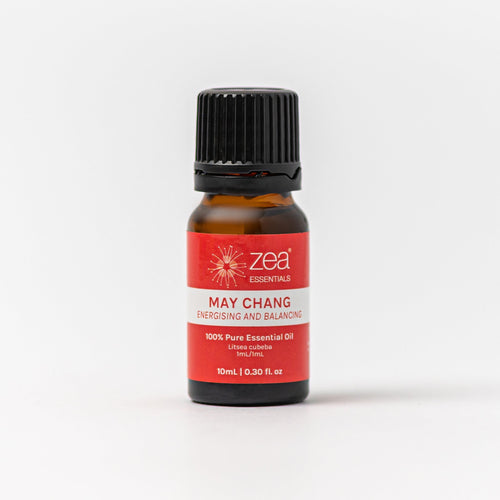
May Chang essential oil smells like a bright, lemony citrus fruit, but the plant it comes from has never grown a citrus fruit in its life. May Chang oil is steam distilled from the small, pepper-sized fruits of Litsea cubeba, a tree in the Laurel family (Lauraceae), the same botanical family as bay laurel and cinnamon, not the Citrus genus. Its citrus-like scent comes from a very high concentration of citral, the same aromatic compound that gives lemongrass its smell, rather than from the limonene and other constituents found in true citrus peel oils. That distinction matters for how you use it, how you dilute it, and whether it carries the sun-sensitivity warning that genuine cold-pressed citrus oils do.

What is May Chang essential oil?
May Chang, also sold as Litsea or Litsea cubeba oil, is steam distilled from the fruit of a small, fast-growing deciduous tree native to subtropical China, Taiwan, and parts of Southeast Asia. The fruit looks a little like a miniature peppercorn, and it is this fruit, not a peel, leaf, or bark, that is distilled to produce the oil. The tree has been used in Traditional Chinese medicine practice for centuries under the name "bi cheng qie," largely for digestive and topical applications, though most of that traditional use predates the kind of controlled research that would let us make specific health claims about it today.
What buyers usually notice first is the smell: sharp, fresh, and unmistakably lemon-like, with a slightly sweeter, less bitter edge than lemon itself. That scent is why May Chang gets grouped with citrus oils in casual conversation, and why the confusion is worth clearing up properly.
Botanical identity at a glance
| Detail | May Chang |
|---|---|
| Botanical name | Litsea cubeba |
| Family | Lauraceae (the Laurel family) |
| Plant part distilled | Fruit |
| Extraction method | Steam distillation |
| Native range | Subtropical China, Taiwan, parts of Southeast Asia |
| Dominant constituent | Citral (neral and geranial) |
| Aroma | Bright, sharp, lemon-like, slightly sweet |
A compositional analysis of Litsea cubeba fruit oil samples from six growing regions in China found that neral and geranial together (the two isomers that make up citral) accounted for between 78.7% and 87.4% of the total oil, depending on region, making citral by far the dominant constituent in every sample tested.1 That single fact explains almost everything about how May Chang smells, blends, and needs to be handled on skin.
Why May Chang smells like citrus but is not one

Scent chemistry, not plant taxonomy, drives what our noses register as "citrusy." Citral, the aldehyde responsible for May Chang's lemon character, also happens to be the dominant compound in lemongrass and in Australia's own lemon myrtle. None of the three plants that carry it in abundance, Litsea cubeba, Cymbopogon citratus (lemongrass), or Backhousia citriodora (lemon myrtle), belongs to the Citrus genus. Meanwhile, true citrus fruits like lemon get their scent mostly from limonene, a completely different molecule, extracted by cold-pressing the peel rather than steam distilling a fruit, leaf, or grass.
This is the heart of the "citrus note that is not a citrus" idea: reach for May Chang when you want that clean, lemony lift without introducing an actual citrus-peel oil, which matters most for the safety reason below.
May Chang vs lemongrass vs lemon vs lemon myrtle
These four oils get confused constantly because they share a family resemblance in scent. Here is how they actually differ:
| Oil | Family | Plant part | Extraction | Dominant constituent | Aroma | Phototoxicity |
|---|---|---|---|---|---|---|
|
May Chang Litsea cubeba |
Lauraceae | Fruit | Steam distilled | Citral, ~79-87%1 | Sharp, sweet lemon | Not phototoxic |
|
Lemongrass Cymbopogon citratus |
Poaceae (grass) | Grass/leaf | Steam distilled | Citral, high | Grassy, sharp lemon | Not phototoxic |
|
Lemon Citrus limon |
Rutaceae (true citrus) | Peel | Cold pressed | Limonene, majority | Fresh, zesty, classic lemon | Phototoxic (contains furocoumarins)4 |
|
Lemon Myrtle Backhousia citriodora |
Myrtaceae | Leaf | Steam distilled | Citral, 90-98%2 | Intensely lemon, slightly sherbet-like | Not phototoxic |
The pattern that matters most is in the two right-hand columns. May Chang, lemongrass, and lemon myrtle all lean on the same aromatic compound, citral, and none of them carries the sun-sensitivity warning. Lemon, by contrast, is a genuine cold-pressed citrus peel oil and does carry that warning, because peel oils contain furocoumarin compounds (such as bergapten) that true citral-dominant oils simply do not.4 If you want a lemony scent for a daytime blend you plan to wear outdoors, that difference is the one worth knowing.
Zea also sells lemon myrtle, our Australian native citral-dominant oil (see our Honey Myrtle monograph for the deeper chemistry of that oil), and true Sweet Orange, a genuine cold-pressed citrus. May Chang sits between them: citrus-scented, non-citrus, non-phototoxic, and distinctly its own oil.
What May Chang smells like and what it blends with
On its own, May Chang reads as sharp and clean rather than sweet or heavy, closer to a fresh lemon rind than to lemon lolly. It sits at the top note in a blend, meaning it is the first thing you smell and the first thing to fade, so it works best paired with something that has more staying power underneath it.
It blends well with woody and floral oils that ground its brightness: Kunzea, Lavender, Cedarwood, Ylang Ylang, and Geranium are common pairings. In a diffuser blend it lifts heavier, earthier oils without dominating them, which is part of why it shows up in Zea's own Clarity Lifestyle Blend. Browse the full range in our essential oils collection if you want to build out a blend from here.
Traditional and documented uses
In Traditional Chinese medicine, the fruit and oil of Litsea cubeba have a long history of use, generally for digestive complaints and as a topical application, under names including "bi cheng qie" and "mountain pepper." That traditional use record is genuinely old, but it predates modern clinical trial methodology, so it should be read as historical context rather than as evidence for any specific health outcome today.
In contemporary aromatherapy, May Chang is most commonly reached for as an uplifting, mood-supportive diffuser oil, and its clean citrus-like scent is popular in natural cleaning and personal care formulations precisely because it delivers a genuine lemon character without cold-pressed citrus oil's sun-sensitivity trade-off. These are traditional and cosmetic uses, not therapeutic claims, and May Chang is sold and should be used as a cosmetic and aromatherapy product, not a registered medicine.
How to use May Chang essential oil
Diffusion
Add 4-6 drops to a standard ultrasonic diffuser with water and run for 30-60 minutes in a well-ventilated room. Its sharp top note means a little goes further than you might expect.
Topical, diluted in a carrier oil
Because May Chang is citral-dominant, keep dilution conservative and always mix into a carrier such as Zea's Unscented Massage Carrier Oil before it touches skin. Citral-heavy oils such as lemongrass carry a professionally recommended dermal maximum as low as 0.7%3, because of the sensitisation potential discussed below. No equivalent figure has been published for May Chang specifically, so the sensible course is to treat that lemongrass maximum as the ceiling rather than the starting point: stay at or below 0.7%, which is roughly one drop of essential oil per 10mL of carrier. Never apply May Chang undiluted to skin.
Bath
Disperse 3-4 drops in a tablespoon of carrier oil or an unscented dispersant before adding to bath water. Neat essential oil floats on the water's surface and can concentrate against skin, so always pre-mix.
Safety: what to know before you use it
May Chang's defining chemistry, a very high citral content, is also its main safety consideration. Citral is recognised as a skin sensitiser at higher concentrations, meaning repeated or concentrated exposure can trigger a reaction in some people even if a first exposure caused none.3 This is a different mechanism from phototoxicity: it is about irritation and sensitisation risk from the citral itself, not about sun exposure.
- Always dilute. Never apply neat to skin. Keep leave-on dilutions conservative, around 1% or lower for general use, and patch test on a small area of inner forearm first.
- Patch test every new bottle. Sensitisation can develop over repeated exposure, so a bottle that felt fine for months is still worth re-testing if you change how often or how concentrated you use it.
- Pregnancy and children. As with most essential oils, consult a healthcare practitioner before use during pregnancy or breastfeeding, and use lower dilutions and closer supervision for children.
- Pets. Cats in particular are far less able to metabolise many essential oil constituents than humans. Do not diffuse around cats in an unventilated space, and never apply directly to any pet's skin or coat.
- No sun-exposure restriction from May Chang itself, unlike a cold-pressed citrus peel oil, but if you blend it with a genuine citrus peel oil (like lemon or bergamot), that blend still inherits the citrus oil's phototoxicity warning.
Frequently asked questions
Is May Chang the same as lemongrass?
No. Both are citral-dominant and smell similar, but May Chang comes from the fruit of a Laurel-family tree (Litsea cubeba) and lemongrass comes from the leaf of a grass (Cymbopogon citratus). They are different plants in different families that happen to share a dominant aromatic compound.
Is May Chang oil phototoxic?
No. May Chang's citrus-like scent comes from citral, not from the furocoumarin compounds that make cold-pressed citrus peel oils like lemon and bergamot phototoxic. Citral-dominant oils are generally not considered phototoxic.4
Why does May Chang smell like citrus if it is not a citrus fruit?
Because scent is driven by specific aromatic molecules, not plant family. May Chang contains a very high concentration of citral, the same compound responsible for the lemon scent in lemongrass and lemon myrtle, so our noses read it as "citrus" even though the plant is unrelated to lemons or oranges.
Can I use May Chang oil undiluted on my skin?
No. Its high citral content makes it a skin sensitiser at higher concentrations, so it should always be diluted in a carrier oil before topical use, with a conservative dilution of around 1% for general use.
What is May Chang oil good for?
It is most commonly used as an uplifting, clean-scented diffuser oil and as a natural lemon-like note in personal care and cleaning blends. Traditional use in Chinese medicine includes digestive and topical applications, though this reflects historical practice rather than modern clinical evidence.
Is May Chang safe to diffuse around children and pets?
Diffusion in a well-ventilated room at a normal drop count is generally considered lower-risk than topical use, but caution is still warranted. Avoid diffusing around very young children or cats in a closed room, and never apply the oil directly to a child's or pet's skin.
References
Sources open in a new tab so you do not lose your place.
- 1. Wang, H. et al. Chemical Composition of Essential Oils of Litsea cubeba Harvested from Its Distribution Areas in China. Molecules, via PubMed Central. View source
- 2. Backhousia citriodora F. Muell. (Lemon Myrtle), an Unrivalled Source of Citral. Foods, via PubMed Central. View source
- 3. Tisserand Institute. Q&A: safety maximums for dermal application. View source
- 4. Cosmetic Ingredient Review. Safety Assessment of Citrus-Derived Peel Oils as Used in Cosmetics. View source